6 use cases and 12 prompts to use Grok like top CEOs.
For many cases it's more powerful and reliable than Perplexity or ChatGPT.
It’s not popular to publicly admit you are using Grok, yet it’s the most capable tool for doing social research, especially on X. And it’s free.
Dave Ricks, CEO of Eli Lilly (a leading pharmaceutical company with market cap $934 billion in early 2026) uses Grok to ask scientific questions.
Wade Foster, co-founder & CEO of Zapier, uses it “to help source under the radar talent is Grok… We’re trying to find some good social media candidates…”:
Grok is like a people finder — is a really helpful tool… You can do the same way if you wanted to find people who just might have product feedback for me… or for influencer marketing.
People agree – ChatGPT lost 35% of active mobile audience last year and Grok grew from 0 to 15%.
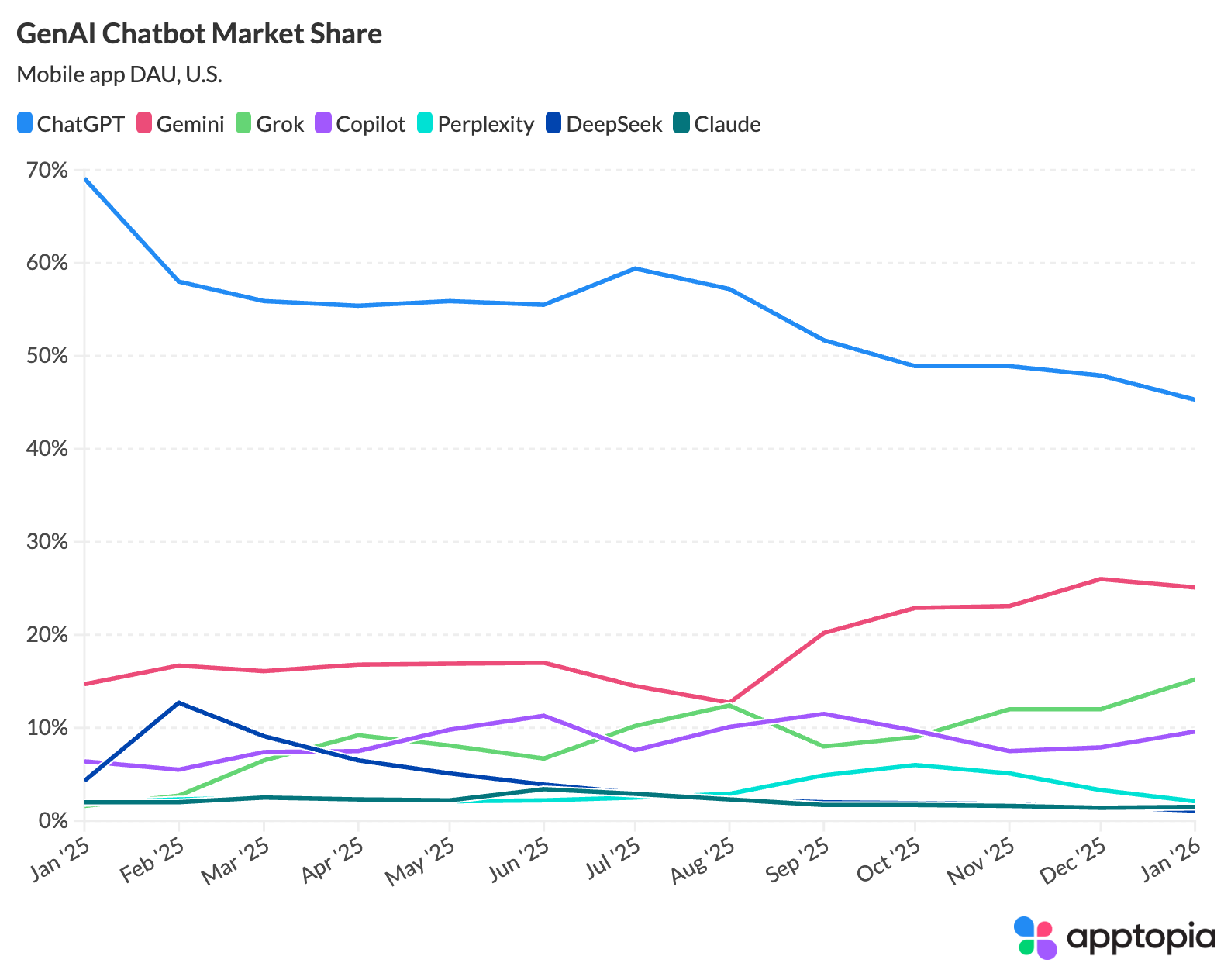
Why so?
Grok has real-time access to X (Twitter) data + web search in the same model. On X people think out loud, before they leave reviews, before they update their LinkedIn. It's the closest thing to unfiltered opinions you'll find online. So market research that used to take 4-6 hours now takes minutes.
And they just launched 4.20 – a multi-agent assistant.
Instead of one model thinking sequentially, Grok 4.20 runs 4 agents in parallel that debate each other before responding: Grok (Captain), Harper (Research), Benjamin (Logic), Lucas (Creative).
Honestly, I don’t really see the difference. It was pretty good at social search and it still is.
These 6 prompts are designed specifically for Grok. They won’t work the same way in ChatGPT or Claude because they depend on X data that only Grok can access.
How Grok’s DeepSearch works (so you understand why these prompts are structured this way):
It breaks your question into sub-searches, pulls from 10+ sources across the web and X, checks them against each other, and gives you a sourced report with the reasoning visible.
It naturally includes source links — but you need to explicitly ask for structured tables, otherwise it defaults to prose with inline citations.
Each prompt below includes a follow-up you run in the same thread to deepen the initial findings.
1. Trend watching & industry pulse
The prompt
Research the most significant emerging trends in {{YOUR INDUSTRY}}
over the last {{14 / 30}} days.
I'm a {{YOUR ROLE}} making decisions about {{WHAT: product roadmap /
investment / content strategy}}. I need signal, not noise.
Search specifically for:
- X threads where {{INDUSTRY}} practitioners debate new approaches
- Recent funding rounds, acquisitions, and product launches
- Shifts in how people talk about the space (new terminology,
new complaints, new excitement)
- Signals from both web sources AND X conversations — compare
what media covers vs. what practitioners actually discuss
EVIDENCE TARGET: Find at least 20 distinct data points
(X posts, articles, announcements, threads). Each must have
a source link. If you find fewer than 20, note which searches
returned thin results so I can adjust.
FORMAT YOUR RESPONSE AS:
**Trend table** (one row per trend, aim for 8-12 trends):
| # | Trend | What's happening | Signal strength (Strong / Emerging / Noise) | Key evidence | Source with link |
Signal strength criteria:
- Strong = multiple independent sources + practitioner discussion on X
- Emerging = few sources but high-quality signals
- Noise = media coverage but little practitioner engagement
Then after the table:
1. **Overhyped**: One trend with lots of buzz but weak evidence
when you look at actual practitioner reactions. Explain why.
2. **Underrated**: One signal most people are probably missing.
Link to the source that convinced you.
3. **Evidence count**: State how many distinct sources you found
and how many were from X vs. web.Follow-up prompt (same thread)
Now go deeper on {{MOST INTERESTING TREND FROM THE TABLE}}.
Search X for the most substantive posts and threads about this
in the last 2 weeks — practitioners with skin in the game,
not media accounts.
TARGET: Find at least 15 more X posts or threads I haven't
seen yet. Different authors, different angles.
Present as a numbered list:
1. [Author name / handle] — [Key point they made] — [Link to post]
Context: [Why their perspective matters]
Then summarize: Who agrees? Who disagrees? What's the strongest
argument on each side?
Running total: You should now have {{20 from first pass}} +
15 new = 35+ evidence points on this topic.Result:
2. Find your audience
The prompt
I sell {{YOUR PRODUCT/SERVICE — 1 sentence}} to {{TARGET AUDIENCE}}.
Help me find where this audience is active and what language
they use when discussing {{THE PROBLEM YOU SOLVE}}.
Search X and the web for:
1. CONVERSATIONS: Recent X posts and threads where people matching
this profile discuss {{PROBLEM DOMAIN}}. I want their exact words.
2. VOICES THEY TRUST: X accounts and web creators that this audience
engages with on this topic. Practitioners with credibility,
not celebrity influencers.
3. GATHERING PLACES: Communities, newsletters, podcasts, and events
where this audience clusters (look for these mentioned in X
bios and posts).
4. LANGUAGE PATTERNS: Specific terms, phrases, and framing this
audience uses when describing the problem and desired solution.
Prioritize X over generic web results. Real conversations >
published content.
QUALITY FILTER FOR X POSTS:
Engagement minimums:
- Likes: {{10+}}
- Retweets/Reposts: {{3+}}
- Replies: {{2+}}
Author authority signals (include at least one):
- Follower count: {{1,000+}}
- Bio matches target audience profile (title, company, domain)
- Regularly posts about {{PROBLEM DOMAIN}}
For EVERY X post included, report: author handle, follower count,
engagement (likes/retweets/replies), and why they match the
target audience.
For web sources: prioritize threads with 5+ replies/upvotes
and verified/active community members.
EVIDENCE TARGETS:
- At least 15 X posts or threads with direct quotes
- At least 10 trusted voices with profile links
- At least 8 gathering places with links or references
- At least 10 language phrases with source links
Total: 40+ linked evidence points minimum.
FORMAT YOUR RESPONSE AS:
**Audience conversations found** (aim for 15+ rows):
| # | Author + authority | Exact quote | Engagement (Likes / Reposts / Replies) | Link |
"Author + authority" format: @handle ({{followers}}, {{role/company}})
**Voices they trust** (aim for 10+ rows):
| # | Name / Handle | Followers | Platform | Focus area | Why audience trusts them | Profile link |
**Where they gather** (aim for 8+ rows):
| # | Community / Channel | Platform | Est. activity level | Link or reference |
**Language map** (aim for 10+ phrases total):
- Problem phrases (how they describe the pain):
1. "{{exact quote}}" — @handle ({{followers}}) — [link]
2. ...
- Solution phrases (how they describe what they want):
1. "{{exact quote}}" — @handle ({{followers}}) — [link]
2. ...
- Rejection phrases (why they say no to existing solutions):
1. "{{exact quote}}" — @handle ({{followers}}) — [link]
2. ...
State your total evidence count and average author follower
count at the end.Follow-up prompt (same thread)
Based on what you found, search X specifically for posts where
someone in this audience:
- Asks for recommendations related to {{YOUR CATEGORY}}
- Complains about their current solution
- Describes a workaround they've built
Same quality filter: {{10+}} likes, {{1,000+}} followers,
target audience profile match.
TARGET: Find at least 15 more posts I haven't seen yet.
These are buying signals.
Present each as:
| # | Signal type (Rec. ask / Complaint / Workaround) | Author + authority | Engagement (Likes / Reposts / Replies) | Quote | Link |
Running total: You should now have 40+ from first pass + 15 new
= 55+ evidence points mapping my audience.3. Pain point discovery
The prompt
Research the biggest pain points that {{TARGET AUDIENCE}} experiences
with {{PROBLEM DOMAIN / PRODUCT CATEGORY}}.
I need real, unfiltered frustrations — not survey summaries. Search for:
ON X:
- Posts where people vent about {{PRODUCT CATEGORY}} problems
- "Am I the only one who..." / "Why can't..." / "I wish..."
patterns about {{TOPIC}}
- Posts describing hacky workarounds (workarounds = unmet needs)
- Reply threads under popular {{INDUSTRY}} posts where complaints
surface in discussion
ON THE WEB:
- Reddit threads about frustrations with {{CATEGORY}}
- Negative reviews of {{COMPETITOR 1}}, {{COMPETITOR 2}},
{{COMPETITOR 3}} on G2, Capterra, or Product Hunt
- Support forums and complaint threads
QUALITY FILTER FOR X POSTS:
Engagement minimums:
- Likes: {{5+}} ← lower than usual because complaint posts
often get fewer likes but are high-signal
- Replies: {{3+}} ← replies on complaint posts = others agreeing
- Retweets/Reposts: {{1+}}
Author authority signals (include at least one):
- Follower count: {{500+}} ← lower bar because real users
complaining matter more than influencer takes
- Bio signals: actual user/practitioner in the space
- Post demonstrates firsthand experience (not quoting someone else)
For EVERY X post included, report: author handle, follower count,
engagement (likes/retweets/replies), and whether this is firsthand
experience or secondhand commentary.
For web sources: prioritize threads with 5+ replies/upvotes,
verified purchaser reviews when visible.
EVIDENCE TARGETS:
- At least 15 X posts with direct complaint quotes and links
- At least 10 web sources (Reddit, reviews, forums) with links
- At least 8 workaround descriptions with links
Total: 30+ linked evidence points in this pass.
FORMAT YOUR RESPONSE AS:
**Pain point table** (aim for 10-15 distinct pain points):
| # | Pain point | User's own words (quote) | Author + authority | Engagement (Likes / Reposts / Replies) | Source + link | Frequency (Pattern / Isolated) | Workaround? |
Frequency criteria:
- Pattern = found across 3+ independent sources
- Isolated = 1-2 mentions (flag as "needs validation")
**Workaround inventory** (aim for 8+ entries):
| # | Pain point | Workaround described | Author + authority | What it tells us about the real need | Source + link |
**Top 5 pain points ranked by opportunity:**
Ranked by: (how widespread) × (how painful) × (how poorly
addressed by current solutions). For each:
1. The pain, in the audience's own words
2. Why existing solutions fail (with evidence)
3. Links to 2-3 highest-engagement posts demonstrating this pain
4. Average engagement on posts about this pain (proxy for resonance)
State your evidence count: X posts found, web sources found,
workarounds found, and average engagement level.Follow-up prompt (same thread)
Of the pain points you found, go deeper on the top 3 with
the strongest workaround evidence.
For each, find at least 7 more X posts or web discussions
confirming the pattern — sources you haven't cited yet.
Same quality filter.
Present as:
**Pain point: {{name}} (avg engagement across evidence: {{X}} likes)**
- Evidence 1: @handle ({{followers}}) — "{{quote}}" — {{Likes / Reposts / Replies}} — [link]
- Evidence 2: @handle ({{followers}}) — "{{quote}}" — {{Likes / Reposts / Replies}} — [link]
- Evidence 3: ...
- Evidence 4: ...
- Evidence 5: ...
- Evidence 6: ...
- Evidence 7: ...
- What a good solution would need to do (inferred from complaints)
That's 21+ new evidence points. Running total: 30+ from first
pass + 21 new = 50+ evidence points on pain points.4. Your product/company: reviews & sentiment
The prompt
Analyze public sentiment around {{YOUR PRODUCT/COMPANY}} over
the last {{30 / 60 / 90}} days.
Search X and the web for honest, unfiltered opinions — not
marketing content, not affiliate reviews.
I need:
1. WHAT PEOPLE LOVE: Features or experiences that generate genuine
positive mentions and unsolicited recommendations.
2. WHAT PEOPLE CRITICIZE: Complaints, frustrations, feature gaps.
Look especially in X reply threads — people are more honest
in replies than in standalone posts.
3. SWITCHING SIGNALS: Posts where someone says they're considering
leaving, actively switching away, or comparing us unfavorably
to an alternative. These are the most urgent.
4. COMPETITIVE CONTEXT: When people mention {{PRODUCT NAME}}, which
alternatives do they compare us to?
5. SENTIMENT SHIFT: Has the tone changed recently? Was there a
specific event that shifted how people talk about us?
{{OPTIONAL: We recently did {{EVENT}} — pay attention to
reactions to this specifically.}}
QUALITY FILTER FOR X POSTS:
Engagement minimums:
- Likes: {{10+}}
- Retweets/Reposts: {{3+}}
- Replies: {{2+}}
Author authority signals (include at least one):
- Follower count: {{1,000+}}
- Bio signals: actual user/customer (not competitor employee,
not affiliate marketer)
- Content pattern: posts about our product category genuinely
For EVERY X post included, report: author handle, follower count,
engagement (likes/retweets/replies), and whether they appear to
be an actual user vs. commentator.
Flag and EXCLUDE: obvious bots, affiliate/referral links,
coordinated promotion campaigns, or posts from our own team.
For web sources: prioritize verified purchaser reviews,
threads with 5+ replies/upvotes.
EVIDENCE TARGETS:
- At least 10 positive mentions with quotes and links
- At least 10 negative mentions / complaints with quotes and links
- At least 5 switching signals with quotes and links
- At least 5 competitive comparison mentions with links
Total: 30+ linked evidence points minimum.
FORMAT YOUR RESPONSE AS:
**Sentiment overview:**
| Metric | Finding |
|--------|---------|
| Overall tone | Positive / Mixed / Negative |
| Tone vs. prior period | Improving / Stable / Declining |
| Most active discussion platform | X / Reddit / Review sites / Other |
| Total evidence collected | {{number}} posts/reviews/threads |
| Avg. engagement of positive posts | {{likes}} / {{retweets}} / {{replies}} |
| Avg. engagement of negative posts | {{likes}} / {{retweets}} / {{replies}} |
**What people love** (aim for 10+ entries):
| # | Feature / experience | Author + authority | Engagement (Likes / Reposts / Replies) | Quote | Source + link |
**What people criticize** (aim for 10+ entries):
| # | Issue | Severity | Author + authority | Engagement (Likes / Reposts / Replies) | Quote | Source + link |
Severity guide:
- 🔴 Churn risk = people saying they're switching or considering it
- 🟡 Friction = complaints but still using the product
- ⚪ Wishlist = "would be nice" — not blocking adoption
**Switching signals found** (aim for 5+):
| # | Trigger | Where they're going | Author + authority | Engagement (Likes / Reposts / Replies) | Quote | Source + link |
**Competitors mentioned alongside us** (aim for 5+):
| # | Competitor | Context (switching to / from / comparing) | Author + authority | Source + link |Follow-up prompt (same thread)
Focus on the 🔴 churn-risk items and switching signals you found.
For each distinct churn trigger, find at least 5 more X posts
or reviews confirming the pattern — sources you haven't cited yet.
Same quality filter: {{10+}} likes, {{1,000+}} followers.
Present as:
**Churn trigger 1: {{description}}**
**Avg engagement across evidence: {{X}} likes, {{Y}} replies**
- @handle ({{followers}}, {{Likes / Reposts / Replies}}): "{{quote}}" — [link]
- How urgent: [assessment based on frequency, recency, and
author authority level]
(Repeat for triggers 2 and 3)
Running total: 30+ from first pass + 15 new = 45+ evidence points.5. Competitor reviews & sentiment
The prompt
Analyze public sentiment around my competitors:
{{COMPETITOR 1}}, {{COMPETITOR 2}}, and {{COMPETITOR 3}}.
My product: {{YOUR PRODUCT + what it does, 1 sentence}}.
We compete on: {{OVERLAP AREA}}.
Time window: last {{90}} days.
For each competitor, search X and the web for:
1. What their users love (genuine strengths I'm up against)
2. What their users hate (recurring complaints and gaps)
3. "Switching from" signals (people leaving — what triggered it?)
4. "Alternative to" conversations (people asking for options)
5. Pricing sentiment (value for money perception)
QUALITY FILTER FOR X POSTS:
Engagement minimums:
- Likes: {{10+}}
- Retweets/Reposts: {{3+}}
- Replies: {{2+}}
Author authority signals (include at least one):
- Follower count: {{1,000+}}
- Bio signals: actual user of the competitor product
- Content pattern: firsthand experience, not secondhand commentary
For EVERY X post included, report: author handle, follower count,
engagement (likes/retweets/replies), and whether they appear to
be an actual user.
Flag and EXCLUDE: competitor employees, affiliate marketers,
obvious promotional content.
For web sources: prioritize verified purchaser reviews,
threads with 5+ replies/upvotes.
EVIDENCE TARGETS PER COMPETITOR:
- At least 4 positive mentions with quotes, engagement, and links
- At least 4 negative mentions with quotes, engagement, and links
- At least 2 switching signals with quotes and links
- At least 2 "alternative to" conversations with links
That's 12+ per competitor × 3 competitors = 36+ evidence
points minimum.
FORMAT YOUR RESPONSE AS:
**Per-competitor table** (one for each):
### {{COMPETITOR NAME}} (evidence count: {{X}})
| # | Category | Finding | Author + authority | Engagement (Likes / Reposts / Replies) | Quote | Source + link |
|---|----------|---------|-------------------|---------------------|-------|---------------|
| 1 | Strength | | | | | |
| 2 | Strength | | | | | |
| 3 | Complaint | | | | | |
| 4 | Complaint | | | | | |
| 5 | Complaint | | | | | |
| 6 | Complaint | | | | | |
| 7 | Switching trigger | | | | | |
| 8 | Switching trigger | | | | | |
| 9 | Pricing | | | | | |
**Cross-competitor gap analysis:**
| # | Unmet need (shared weakness) | Which competitors fail here | Evidence strength (Strong / Moderate / Weak) | Avg. engagement on related posts | Best evidence link |
**"Alternative to" conversations found** (aim for 6+):
| # | What they're looking for | Competitor leaving | Author + authority | Engagement (Likes / Reposts / Replies) | Quote | Link |
After the tables:
- **Best positioning opportunity**: Gap with strongest evidence.
Include: combined engagement across posts about this gap.
- **Where NOT to compete**: Where competitors are strong and
high-authority users confirm it.
- **Total evidence count** across all competitors. Average author
follower count and engagement level.Follow-up prompt (same thread)
For the biggest gap you identified in the cross-competitor table,
search X for people actively looking for a solution to that
specific problem RIGHT NOW — posts from the last 30 days.
Same quality filter: {{10+}} likes, {{1,000+}} followers.
TARGET: Find at least 15 posts or threads. Different people,
different contexts.
Present as:
| # | @handle | Followers | Role/company | What they need (quote) | Engagement (Likes / Reposts / Replies) | Post link | Date |
Then for any competitor where you found fewer than 12 evidence
points in the first pass, search again and fill in the gaps.
Running total: 36+ from first pass + 15 prospect posts
= 50+ evidence points on the competitive landscape.6. People search: talent, customers, or future manager
⚠️ Ethics note: These prompts use only publicly shared information. Use them to prepare, not to surveil. Respect boundaries.
For finding talent or prospects:
Search X for people who match this profile:
{{ROLE + SENIORITY + SKILL SET + GEOGRAPHY (if relevant)}}
I'm looking for signal, not résumés:
- People who post substantively about {{RELEVANT TOPICS}}
- People who share their work, projects, or opinions on
{{RELEVANT DOMAIN}}
- People who engage in professional discussions, not just
retweet news
QUALITY FILTER FOR PEOPLE:
Minimum authority signals:
- Follower count: {{1,000+}} ← adjust: 500+ for niche/technical,
5,000+ for senior/executive
- Bio: job title and domain visible
- Activity: posted about {{RELEVANT TOPIC}} at least
{{3+}} times in the last 90 days
- Engagement on their posts: average {{5+}} likes
(shows their content resonates)
EVIDENCE TARGET: Find at least 15 people. For each person,
include at least 1 specific post that demonstrates expertise
with engagement metrics. That's 15 profiles + 15 posts = 30+
linked evidence points.
FORMAT YOUR RESPONSE AS:
**People found** (aim for 15+ rows):
| # | @handle | Followers | Current role | Posts about | Top post + engagement (Likes / Reposts / Replies) | Post link | Relevance (High / Med) |
Relevance criteria:
- High = active on-topic posting + clear expertise + engagement
above threshold
- Medium = relevant profile but lower activity or engagement
**Top 5 — engagement angles:**
| # | @handle (followers) | Specific recent post to reference | Engagement (Likes / Reposts / Replies) | Post link | Personalized outreach angle |
State: Total people found, average follower count, average
engagement level, how many rated High vs. Medium relevance.Follow-up for talent/prospect search:
For the top 5 High-relevance people, go deeper. For each one,
find 3 more of their recent posts that show their thinking,
expertise, or priorities. Each post must have {{5+}} likes.
Present as:
**@handle ({{followers}}, avg {{X}} likes/post):**
- Post 1: "{{key point}}" — {{Likes / Reposts / Replies}} — [link]
- Post 2: "{{key point}}" — {{Likes / Reposts / Replies}} — [link]
- Post 3: "{{key point}}" — {{Likes / Reposts / Replies}} — [link]
- What this pattern tells us about reaching them
Running total: 30+ from first pass + 15 = 45+ evidence points.For researching a specific person (interview prep / sales call prep):
Research {{FULL NAME}}, {{ROLE}} at {{COMPANY}}.
Search their X posts, blog posts, podcast appearances, conference
talks, and public writing from the last 12 months.
QUALITY FILTER: Include all their posts, but highlight the
ones with highest engagement (most likes, most replies, most
reposts) — these show what resonated with their audience and
what they're known for.
EVIDENCE TARGET: Find at least 20 distinct pieces of public
content from this person. Each with a link. For X posts,
include engagement metrics.
FORMAT YOUR RESPONSE AS:
**Profile overview:**
| Field | Finding | Source + link |
|-------|---------|---------------|
| Followers / audience size | | |
| Topics they care most about | | |
| Stated views on {{RELEVANT TOPICS}} | | |
| Recent projects / initiatives | | |
| Communication style | | |
| Their most-engaged content (top 3 posts by likes) | | |
**Key posts and public content** (aim for 15-20 entries):
| # | Topic | What they said / argued | Engagement (Likes / Reposts / Replies) | Source + link | Date |
Sort by engagement (highest first) — their most popular
content reveals what their audience values about them.
**Meeting prep:**
- 3 things to know going in (with source links for each)
- 2 smart questions to ask, based on their highest-engagement
posts (link to what inspired each question)
- 1 thing NOT to assume (common misconception their posts correct)
State: Total content found, platforms searched, their
average engagement level, and date range of evidence.If Grok returns fewer results than requested
It happens — some niches just don't have much public discussion. What to do:
Push for more in the same thread: “You found {{X}} posts. I need at least {{Y}} more. Search again with broader keywords, synonyms, or platforms you haven’t checked yet.”
Lower the quality thresholds: “Drop the engagement minimum to 3+ likes and 300+ followers and search again.”
Accept the signal: If Grok genuinely can’t find 30 complaints about your product, that might be the finding — low public discussion volume is data too. Note it and move on.
What DeepSearch is and isn’t
Final thoughts
Grok isn't better than ChatGPT or Claude at everything. But for social research — it wins. Real-time X data, unfiltered opinions, source links you can verify. No other model does that better. Don't get stuck being loyal to one AI though. Pick the right tool for the job. Grok for social listening. Claude for text. ChatGPT for general stuff. AI is a commodity, not a luxury. Use all of it.
Comment with your best Grok use case — I'll feature the top ones in the next issue.
With gratitude for your curiosity, Alena


Thanks for sharing